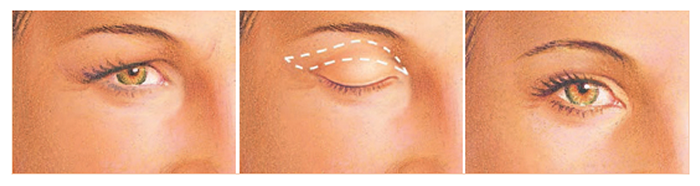
Eyelid surgeries are delicate surgical procedures. This must be done with great care and balance to give a good result to the patient. Patients who come to Dr. Jacobsen for correction of the upper eyelid generally have too much skin that tends to dangle down, which can give the appearance of advanced age or can also inhibit vision by blocking some of the field of view.
Removal of this extra skin in the upper eyelid, for the most part, can be performed under local anesthesia in Dr. Jacobson’s comfortable office suite. This skin removal of the upper eyelid is called a blepharoplasty and can usually be performed safely in less than an hour.
Sometimes insurance will cover the removal of the skin if it is physically blocking more than 50% of your visual field in one direction. This can be measured by your optometrist or ophthalmologist with a “field of vision view”. Your insurance company will have a policy outlining what it covers and what it does not. If your insurance company does not cover this procedure, Dr. Jacobsen and his staff charge a reasonable fee for it to be performed in the office under local anesthesia. It is pretty rare for it to be covered, and we do not assist with your coverage efforts.
At times, however, the operation must be done under general anesthesia in the Hospital if there is extensive skin to be removed or additional bulging of fat that requires removal. Usually, the upper eyelid incision heals very well and is hidden very nicely, as the upper eyelid gets tucked back into the orbit when you open your eyes.
The lower eyelids are more complicated and usually require light general anesthesia to perform safely. These required incisions are placed directly under the lower eyelid, and the fat is dissected, bulging underneath the eyeball and causing the eyelid to bulge out. Typically, the reason the lower eyelid looks too bulky is that the fat around the orbit is beginning to bulge out as you age. Sometimes, however, additional skin needs to be removed. The lower eyelid procedure is more complex, but it can be performed safely under anesthesia.
Patients mostly believe that the lower eyelids have excess skin and that it needs to be removed. This is generally true, but the main problem is the fat around your eyeball. This fat around your eyeball tends to herniate beneath the eyeball and protrude, forming a bag under your eye. So removing some of the fat around your eyeball helps flatten the contour under your eyeball, in addition to removing some of the skin.
The incisions are finally closed with very fine suture material. Usually, Dr. Jacobsen uses 7-0 Vicryl absorbable suture material. The suture material is dissolvable and usually falls out on its own after about 2 weeks. The incisions are sealed with a fine layer of DermaBond, a cyanoacrylate most like superglue, except it is sterile and flexible. This seals the incision, prevents bleeding, and allows you to shower immediately after surgery.
The incisions after surgery required no creams or ointments, and no specific care other than keeping them clean and dry with antibacterial soap and water. You may shower directly after the incision as well. It is best to treat the eyelids after surgery with ice, taking care not to freeze the skin with direct icing but using indirect icing with frozen peas in thin Ziploc bags or masks that can be obtained at the pharmacy that are filled with gel that can be frozen and interchanged throughout the first day or 2 after surgery. After the first 24 or 48 hours, ice or cold packs will no longer help alleviate swelling. On the first day, this can be very comforting, helping prevent additional bruising and minimizing swelling. The best way to reduce the swelling, however, is to avoid lifting and straining after the operation. Even bending over to load the dishwasher can often allow your face to fill up with blood and feel congested, causing potential bruising or bleeding. It is best not to bend over or lift, and to enable your family to help you with car doors and heavy doors wherever you are. You should sleep with the head of your bed elevated at least 30°, with an extra pillow, which helps a great deal as well. Your blood pressure should also be maintained in a normal range. Bruising tends to resolve over time and is always disappointing when it occurs around the patient’s eyelids. This always goes away with time. It is best to avoid this as much as possible with your own postoperative care. If you are considering an eyelid lift in Phoenix, feel free to contact Dr. Jacobsen’s Office with any questions or to schedule an appointment today!
Step 1 – Anesthesia
Medications are administered for your comfort during the surgical procedure. The choices include oral or intravenous sedation or general anesthesia. Dr. J will recommend the best option for you. The upper eyelids are often performed in the office, but the lower eyelids require surgery in the surgery center. In the office, an extremely small needle, 32-gauge, is used to comfortably numb your skin. We wait 10 minutes for the medicine to take effect, then Dr. J performs your upper eyelid surgery. We provide a gel-filled eye mask to wear for the first two days. Always best to have someone come with you and drive you home, but an Uber or Waymo is fine. The stitches are usually removed about 10 days after surgery. You will be in the office for about an hour. Usually, we give you a Valium 5mg tablet to take before you come in for your surgery. Dr. J asks that once we begin, there is no talking, so you can be as still as possible!
Because the lower eyelid incisions are made when the lift is performed, he is directly along the margin of the eyelashes rather than above or below the eyelashes. It is very close to the globe of your eyeball, which must be protected with a corneal protector, which is a plastic device that is inserted over your eye, much like a shield to protect your eye during the surgery. This is uncomfortable while you are awake. You will be much more comfortable being asleep, which allows me to do the surgery more safely for you so that you are exquisitely comfortable and exquisitely still, so the fine details of your eye, the lift can be done efficiently and perfectly. Once the surgery is complete, you will be very comfortable, as the eyeball is carefully irrigated with a sterile ophthalmic solution before you wake up.
Step 2 – The incision
The incision lines for eyelid surgery are designed so the resultant scars will be well concealed within the natural structures of the eyelid region.
The upper eyelid can be corrected through an incision within the natural crease on the eyelid. This allows for the removal or repositioning of fat deposits, tightening of muscles, and removal of excess skin.
 Conditions of the lower eyelid may be corrected with an incision just below the lower lash line. Through this incision, excess skin in the lower eyelid is removed. Again, the excess fat can be repositioned or removed.
A transconjunctival incision, created on the inside of the lower eyelid, is an alternate technique to correct lower eyelid conditions and redistribute or remove excess fat. With this technique, no skin is removed.
 Step 3 – Closing the incisions
Eyelid incisions typically are closed with:
- Removable sutures
- Skin adhesives
- Surgical tape
Upper Eyelid “Lift” Phoenix Pricing
| Total All-Inclusive Fees | $ | 3,000 |
| Dr Js Surgical Fees -Office under local ANES | $ | 3,000 |
Note: This is a pre-examination estimate that is appropriate for most patients wishing this service. The fees may change slightly based on your personal needs.
Lower Eyelid “Lift” Phoenix Pricing
| Total All-Inclusive Fees | $ | 5,500 |
| Dr Js Surgical Fees | $ | 4,000 |
| Payment to Dr Jacobsen | $ | 4,000 |
| Estimated Anesthesia Fee | $ | 750 |
| Payment to St Joe’s SurgiCenter | $ | 750 |
| Total Payments | $ | 5,500 |
Note: This is a pre-examination estimate that is appropriate for most patients wishing this service. The fees may change slightly based on your personal needs and surgery center/anesthesia fee schedules. Final pricing for surgery will be provided at consultation.
Upper & Lower Eyelid “Lift” Phoenix Pricing
| Total All-Inclusive Fees | $ | 8,255 |
| Dr Js Surgical Fees | $ | 6,000 |
| Payment to Dr Jacobsen | $ | 6,000 |
| Estimated Anesthesia Fee | $ | 880 |
| Payment to St Joe’s SurgiCenter | $ | 1,375 |
| Total Payments | $ | 8,255 |
Note: This is a pre-examination estimate that is appropriate for most patients wishing this service. The fees may change slightly based on your personal needs.
If you are considering surgery, below is the Consent form for you to read prior to your Surgery
Informed Consent
Blepharoplasty Surgery
William M. Jacobsen, M.D., FACS
Cosmetic & Restorative Surgery
2525 East Arizona Biltmore Circle Suite C236 Phoenix, AZ 85016
Phone 602.212.0100 Fax 602.279.1701
Secure Text: 623.888.8152
©2020 American Society of Plastic Surgeons®. Purchasers of the Informed Consent Resource are given a limited license to modify the documents contained herein and reproduce the modified version for use in the Purchaser’s own practice only. The American Society of Plastic Surgeons® does not authorize the use of these documents for purposes of any research or study. All other rights are reserved by the American Society of Plastic Surgeonsâ. Purchasers may not sell or allow any other party to use any version of the Informed Consent Resource, any of the documents contained herein, or any modified version of such documents.
INSTRUCTIONS
This document will help you learn about blepharoplasty surgery. It will outline the risks and other treatments.
It is important that you read the whole document carefully. Please initial each page. Doing so means you have read the page. Signing the consent agreement means that you agree to the surgery that you have talked about with your plastic surgeon.
GENERAL INFORMATION
In this surgery, excess skin and muscle from the upper and lower eyelids are removed. Fat under the eyelids makes the skin look baggy. This fat can be moved or removed to reduce sagging skin. It can also improve vision in older patients who have eyelid skin hanging over the eyes. Though this surgery adds an upper eyelid fold, it does not take away traces of one’s racial or ethnic roots. It cannot remove wrinkles or “crow’s feet.” It does not fix dark circles under the eyes or lift sagging eyebrows.
Blepharoplasty surgery is specific to each patient, depending on his or her needs. It can be done on either the upper or lower eyelid, or both. It can be done alone or with other procedures to the eye, face, eyebrow, or nose. In patients with loose skin between the lower eyelid and the eyeball, the lower eyelid may be tightened (canthoplasty/canthopexy) at the time of blepharoplasty. This surgery cannot stop aging. It can only reduce loose skin and bagginess around the eyes.
OTHER TREATMENTS
Other treatments include not having surgery. Loose skin, fat deposits, and wrinkles can be fixed by a brow lift. Other surgeries can be done to fix eyelid function problems. Such problems could include drooping eyelids owing to muscle problems (eyelid ptosis) or looseness between the eyelid and eyeball (ectropion). Chemical peels, laser resurfacing, or other skin treatments can fix minor wrinkles. All treatments have their own risks and problems.
RISKS OF BLEPHAROPLASTY SURGERY
Every surgery has risks. It is important that you understand these risks and the possible problems. All procedures have limits. Choosing to have a surgery means comparing the risks and benefits. Most patients do not face problems, but you should talk about them with your plastic surgeon. Make sure you understand all possible outcomes of a blepharoplasty.
SPECIFIC RISKS OF Blepharoplasty SURGERY
Blindness:
Blindness is very rare after surgery. It can be caused by internal bleeding around the eye during or after surgery. This cannot be predicted.
Dry Eyes:
Surgery can cause permanent problems with tear production. This is rare and cannot be predicted. People with dry eyes should think twice before going in for this surgery.
Ectropion:
In some cases, the lower eyelid may move away from the eyeball. This is a rare problem that can occur during lower lid surgery. More surgery may be needed to fix this.
Cornea Exposure:
Some patients have trouble closing their eyelids after surgery. This may be due to dryness in the cornea. More treatment may be needed to fix this.
Eyelash Loss:
You may lose lashes in the lower eyelid where the skin was lifted during surgery. This is not predictable. Eyelash loss may be temporary or permanent.
Asymmetry:
Surgery may cause changes in the way the eyes look. You may also see changes in eye opening level, eye shape, position of the lid fold, and size of the eyes. There are always minor differences in the size of the eyes, bones of the eye socket, and skin near the eyes. This may be more obvious after surgery. You may need more surgery to fix this. In some cases, the differences may not be fixable.
DISCLAIMER
Informed consent documents give you information about a surgery you are considering. These documents explain the risks of that surgery. They also discuss other treatment options, including not having surgery.
However, informed consent documents can’t cover everything. Your plastic surgeon may give you more or different information. This may be based on the facts of your case.
Informed consent documents are not meant to define or serve as the standard of medical care. Standards of medical care are determined based on the facts involved in an individual case. They may change with advances in science and technology. They can also change with the way doctors practice medicine.
It is important that you read the above information carefully and get all your questions answered before signing the consent agreement on the next page.
CONSENT FOR PROCEDURE OR TREATMENT
- IpermitDr. William Jacobsen and the doctor’s assistants to do procedure Blepharoplasty Surgery.
- Igotthe information sheet on Blepharoplasty Surgery.
- 3. Iunderstandthat, during the surgery, an unexpected situation may require a different medical procedure than the surgery listed I permit the doctor listed above, the assistants and/or designees to provide any treatment that my doctor thinks is needed or helpful. My permission includes all treatments that my doctor does not plan to do at the start of the surgery.
- 4. I understand what my surgeon can and cannot do. Iunderstand that no warranties or guaranteeshave been hinted at or stated outright about the outcome of the I have explained my goals. I understand which outcomes are realistic and which are not. All my questions have been answered. I understand the surgery’s risks. I am aware of other risks and possible issues, benefits, and options. I understand and choose to have the surgery.
- I agree to the anestheticsthatare needed or helpful. I understand that all types of anesthesia have risks and may result in complications, injury, and even death.
- 6. I am awareof the seriousrisks to my health when blood products are used. I agree to my doctor using them if my doctor, assistants, and/or designees think they are needed or helpful.
- 7. Iagreeto the disposal of any tissue, medical devices, or body parts taken out during or after I also agree to any additional surgeries or treatment that is needed or helpful.
- 8. Iagreeto have parts of my body photographed or televised appropriately before, during, and after the surgery for medical, scientific, or educational reasons, if the pictures do not reveal my identity.
- 9. For medical education, Iagree thatonlookers can be in the operating room.
- Ipermitmy Social Security Number to be given to the right agencies for legal reasons and medical device registration, when necessary.
- 11. I agree to thechargesfor this I understand that the doctor’s charges are separate from the charges for the hospital and the anesthesia. I understand that there may be more charges if more procedures or treatments are needed or helpful. I agree to those charges, if any.
- 12.I understand that not having the surgery is an option and that I can opt-out of having the surgery.
- 13. IT HAS BEEN EXPLAINED TO ME IN A WAY THAT I UNDERSTAND:
- THEABOVESURGERY TO BE PERFORMED
- THEREMAY BEOTHER SURGERIES OR TREATMENT OPTIONS
- THEREARE RISKS TO THESURGERY

Dr J and his staff look forward to understanding the details of your unique case, desires and aspirations, and to providing you with realistic, safe and attainable results that leave you looking beautiful, and truly feeling like yourself. Take the first step toward your healing or rejuvenating procedure with Dr J by filling out our contact form to request a consultation, or to inquire about any of the services we offer. We look forward to treating you!
Self-verified patient of Dr. William M Jacobsen - Posted on February 3rd, 2018 Self-verified patient of Dr. William M Jacobsen - Posted on February 25th, 2018 Self-verified patient of Dr. William M Jacobsen - Posted on February 4th, 2018
4.8 Average Rating | Click to view over 386 reviews
 Dr. William Jacobsen and his entire staff are all very educated, professional and extermly responsive to any questions or concerns. They set up very real expectations for me after taking the time to help me understand what was hoped to be achieved. I have been treated with the highest respect and kindness. Dr. Jacobsen has an extraordinary bedside manner and met my needs and expectations in every way! With future facial and cranial reconstructive surgery to be performed, I am confident in facing the future with the care and golden hands of Dr. Willaim Jacobsen. Dr. J fixed a terrible scar on my face left by a dermatologist. His expertise made the process as pleasant as possible. His staff was wonderful and caring. Very Happy with my experience with staff, surgery 51 days out and Dr Jacobsen attn to detail. Professional & courteous staff and available and responsive to questions after procedure. I would recommend Dr. Jacobsen and his staff.
Dr. J has an amazing personality and the surgery was quick, painless, and perfect. I didn’t even need to take any painkillers after I woke up. I look and feel so much better. Would highly recommend him to anyone considering surgery. The staff was also incredibly easy to work with. All around great office energy and the medical staff at the surgery center are so sweet. I’m 9 days post op and I’m very happy with the results so far (still healing). Dr. J is easy to talk to. I went in for a consult and was able to schedule the procedure for the very next week. All went very well. I was so afraid to remove the bandages - I was expecting a bloody/bruised mess. I was pleasantly surprised to see tiny incisions with no scabbing or bruising. I’m very impressed. Enjoyed meeting and working with Dr. J. I had an eye lift and it was a pleasant experience from start to finish. Dr. J’s bed side manner is very personable and genuine. He explained everything step by step and made the procedure very painless. Even though I’m from Minnesota - I will be coming to Dr. J for any future cosmetic surgical needs. I cannot recommend Dr. J enough. What a brilliant human! I’m so thankful for finding this amazing genius. I’ve struggled with skin sagging since my weight loss surgery. My arms were my nemesis, I have other skin removal surgeries to have in the future but my arms were really my starting point and I had went to try to freeze the remaining stubborn fat and skin to hopefully shrink. Yeah that didn’t work. Then I found this guy, he’s awesome, his staff is awesome and professional and I cannot say thank you enough to this life changing leap into the rest of my journey. I truly and blessed to have had the opportunity to be able to experience the joy he has for his craft. He has truly changed my life. Thank you Dr. J. I, Theresa Buschbacher, prepared this review and submitted it on my husband,s account.
Superb, Excellent, Caring, Compassionate, Knowledgeable, Experienced, these are all descriptive terms that one must earn. Dr.J has completely filled the requirements of each and every of these terms and they can all equally be applied to him.
His knowledge immediately puts you at ease (and when what he says will happen does actually happen, you get a big smile inside and you know you have a relationship with an excellent doctor)!
Now for the support staff, they relate to you and express a genuine concern for what you are going through. They work with you and put you at ease while accomplishing what is needed for the “business end” of the doctor’s office.
This is a WINNER!! Dr. Jacobsen and his staff did such an amazing job taking care of me. Went in for my consultation on Tuesday and they were able to get me in surgery by Thursday. By far the best prices in the valley after searching everywhere! Incredible care! I have referred all my friends to Dr. Jacobsen! I got in right away. I felt very reassured that I was in very professional caring hands. I highly recommend Dr. Jacobsen. The staff was very friendly. The office was very nice and comfortable. My experience was beautiful. I’m very thankful to have been his patient today. ❤️ This will be a long review but worth the read! I'm beyond impressed with the overall quality, cleanliness, prices, customer service and results.
First impressions, their branding of their classy theme provided an elegance that I felt right at home. I felt like a king who was going to get the best treatment!
Secondly, very clean... I mean this place was immaculate! You can tell these folks worked hard to build their business and put in the work to upkeep it! As a business owner myself I applaud the way they conduct their business and never loose their family values, that caring, compassionate, family oriented value that most businesses start off with but loose over time. I can tell that money is not their passion. Their customers results are, the smiles and cries one has when they see their results.
I was terrified of anesthesia, and when I expressed my concerns about my PTSD the surgeon, anesthesiologist and staff all took the time to sit with me and listen to me then proceed with a break down of how well they were going to take care of me and make sure I have the best experience possible. In which I certainly did! And best part I didn't wake up out of it, scared, panicking or anything like that. I was a little tired of course, but I went live for my fans soon as I got in the car. I felt comfortable the entire time I was waiting and when my nerves were really high I was honest and told them. They put in the extra love to make sure I was ok. When I went back and they gave me whatever magical cocktail, I felt as my procedure was 4 seconds. I didn't wake up during surgery, didn't hear anything nor wake up in pain! Everything they could have possibly done right they absolutely did! I felt safe too. And when I had questions after they were great about responding and following up. The cleanliness was great, and they took all precautions during this time of COVID-19.
I knew the day I met Dr. Jacobson during my consultation that he had to be my surgeon! I hope this review helps viewers make that final decision on choosing Dr. Jacobson as their surgeon and if anyone has questions you are more then welcome to ask and I will answer to the best of my abilities?
Thank you Dr. Jacobson and your staff?? my results are incredible! And I'm not even fully healed yet and I can't stop staring at my chest! It's a dream come true and it wouldn't have be possible without you and your staff. God bless! Got my breast augmentation and lift done here so amazed and pleased with the results hands down a wonderful surgeon and gentleman 5stars all the way around Dr J is absolutely brilliant. His office and staff are out of this world and his demeanor is so friendly and up beat. He makes you feel like you are in the best possible hands... And you are! The Surgeon I met with before I saw Dr J told me I would need a general anesthetic for my surgery and likely a skin graft. I was terrified. Went to Dr J for a second opinion and he was totally nonchalant about what needed to be done. He did it a week later in his office with just some local freezing and it was amazing! No problems at all. I would never see another Dr for surgery. Dr J is truly above the rest! Even his peers give him awards. His office is full of them! Big hugs to him and his staff for turning this in a happy ending from a scary start.
4.6 Average Rating | Click to view over 185 reviews
I had a small mole removed from my nose. Dr. Jacobsen explained that he could help me by removing it. His beautiful office and loving staff members put me at ease beforehand . Dr. Jacobsen did a great job numbing the area and he removed the mole while I was awake. I didn't feel anything and recovery was essentially painless. I also engaged in public activities with a small dressing on and no one noticed. My incision healed beautifully and the post care instructions were easy to follow. Jan 25, 2018 Dr. Jacobsen put me immediately at ease and his expertise fixed a bad scar left by a dermatologist. I can’t recommend him strongly enough. Feb 25, 2018 Dr. Jacobsen is an amazing surgeon. He is always available for questions, or concerns. The staff is more helpful than another office I've been to. They go over and beyond helping with insurance, appointments or any other concern. Dr. Jacobsen, and his staff are always kind, and just great all around. The office is both beautiful, and comfy. As you can see I could, and do go on and on Jan 25, 2018

4.8 Average Rating | Click to view over 210 reviews

 Crystal Greer
July 12, 2021  Olimpia Garner
April 24, 2021  Trudy Hart Petersen
April 24, 2021  Sholeena Gable
January 8, 2021  Mike Buschbacher
December 16, 2020  C D
C D
November 13, 2020  Aimee Beth
November 6, 2020  Darian Terrell
October 12, 2020  Jessica Shipman
October 3, 2020  Michelle Suzuki
October 2, 2020
Get started today!
Dr J and his staff are committed to providing you with exceptional and compassionate care. On behalf of our entire team, we invite you to request a consultation to talk to Dr J about your goals, expectations and aspirations. We can’t wait to find out how our 20-plus years of experience in cosmetic and functional plastic surgery can help change your life, and make you a happier, healthier person.
Dr. William Jacobsen
Plastic Surgery
2525 East Arizona
Biltmore Circle, Suite C236
Phoenix, AZ 85016
Phone: 602-212-0100
Fax: 602.279.1701
info@drjsoffice.com
Our Procedures & Treatments
Dr J considers every surgery an opportunity to express his vision with his patients, and believes in natural, beautiful results that leave you feeling confident and beautiful, but most importantly, feeling like yourself. From extremely rare and complex surgical cases, to cosmetic surgery, Dr J has the experience, compassion and understanding to help you achieve your surgical goals.